Agenta
Agenta is the open-source platform for teams to build and manage reliable LLM apps together.
AI tool Details
Explore More
Alternatives
About Agenta
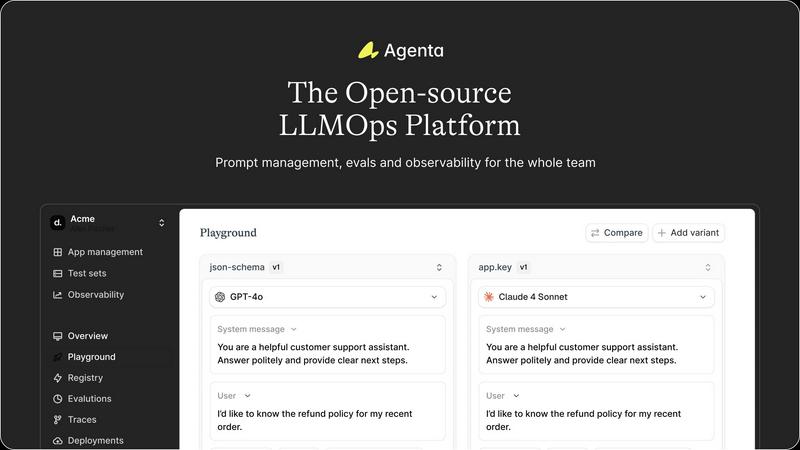
Agenta is the open-source LLMOps platform designed to transform how AI teams build and ship reliable applications powered by large language models. It directly tackles the core challenge of LLM unpredictability by replacing scattered, chaotic workflows with a centralized, collaborative environment for the entire development lifecycle. Built for cross-functional teams, Agenta brings developers, product managers, and subject matter experts into a single, intuitive workflow. It eliminates the frustration of prompts lost in emails and spreadsheets and debugging that feels like guesswork. The platform's core value lies in seamlessly integrating the three critical pillars of modern LLM development: prompt management, systematic evaluation, and production observability. This unified approach allows teams to experiment rapidly, validate every change with concrete evidence, and efficiently debug issues, dramatically accelerating time-to-production while reducing risk. As an open-source and model-agnostic solution, Agenta provides the flexibility to use any model or framework, preventing vendor lock-in and empowering teams to choose the best tools for their specific application needs.
Features
Unified Playground & Prompt Management
Agenta provides a central playground where teams can experiment with, compare, and version-control prompts and models side-by-side in real-time. This creates a single source of truth, ending the chaos of prompts scattered across different tools. You get complete version history for every change, enabling seamless rollbacks and clear audit trails. The platform is model-agnostic, allowing you to integrate and test models from any provider without being locked into a single vendor's ecosystem.
Systematic Evaluation & Testing
Move beyond gut feelings with Agenta's robust evaluation framework. It enables you to create a systematic process for running experiments, tracking results, and validating every change before it ships. You can integrate any evaluator, including LLM-as-a-judge, custom code, or built-in metrics. Crucially, you can evaluate the full trace of an agent's reasoning, not just the final output, and incorporate human feedback from domain experts directly into the evaluation workflow for comprehensive validation.
Production Observability & Debugging
Gain deep visibility into your live LLM applications. Agenta traces every production request, allowing you to pinpoint exact failure points when issues arise. You can annotate traces with your team or gather direct feedback from end-users. A powerful feature lets you turn any problematic trace into a test case with a single click, closing the feedback loop between production and development. Monitor performance and detect regressions automatically with live, online evaluations.
Collaborative Workflow for Teams
Agenta breaks down silos by providing a unified workspace for all stakeholders. It offers a safe, no-code UI for domain experts to edit and experiment with prompts. Product managers and experts can run evaluations and compare experiments directly from the interface. The platform ensures full parity between its API and UI, allowing both programmatic and manual workflows to integrate seamlessly into one central hub, fostering true collaboration.
Use Cases
Accelerating Agent & Chatbot Development
Teams building conversational AI, customer support agents, or complex multi-step AI agents use Agenta to manage the intricate prompt chains and reasoning steps. The unified playground allows for rapid iteration on system prompts and tools, while full-trace evaluation ensures each step in the agent's logic is performing correctly before deployment, leading to more reliable and effective autonomous systems.
Streamlining LLM-Powered Feature Rollouts
When product teams need to integrate LLM features (like content summarization, classification, or generation) into an existing application, Agenta provides the controlled environment to test and evaluate these features. PMs can collaborate with engineers to run A/B tests on different prompts or models, using systematic evaluations to gather evidence on what works best before a full production release.
Managing Enterprise Prompt Portfolios
Large organizations with multiple teams deploying various LLM applications use Agenta as a central governance platform. It prevents duplication of effort and maintains consistency by offering a centralized repository for all prompts and their versions. Subject matter experts across different departments can contribute to and evaluate prompts relevant to their domain within a secure, managed environment.
Debugging and Improving Live AI Systems
When an LLM application in production exhibits unexpected behavior or a drop in performance, engineers use Agenta's observability features to diagnose the issue. By examining detailed traces, they can isolate the failure to a specific prompt, model call, or data input. They can then save the error as a test case, debug it in the playground, and validate the fix through evaluation, ensuring the same error does not reoccur.
Frequently Asked Questions
Is Agenta really open-source?
Yes, Agenta is fully open-source. You can dive into the code, self-host the platform, and contribute to its development on GitHub. This model provides maximum flexibility, prevents vendor lock-in, and allows teams to customize the platform to fit their specific infrastructure and security requirements.
How does Agenta handle collaboration between technical and non-technical roles?
Agenta is built specifically for cross-functional collaboration. It provides a user-friendly, no-code web interface that allows product managers and domain experts to safely edit prompts, run evaluations, and compare experiment results without writing any code. This bridges the gap between teams, ensuring everyone works from the same centralized data and workflow.
Can I use Agenta with my existing LLM framework and model providers?
Absolutely. Agenta is designed to be model-agnostic and framework-agnostic. It seamlessly integrates with popular frameworks like LangChain and LlamaIndex, and can work with models from any provider, including OpenAI, Anthropic, Google, and open-source models from Hugging Face. You bring your own models and APIs.
What is the difference between evaluation and observability in Agenta?
Evaluation in Agenta refers to the systematic testing and scoring of prompts and models during development, typically on curated test datasets, to validate performance before deployment. Observability, on the other hand, is about monitoring the live, production application. It involves tracing real-user requests, debugging issues as they happen, and using that production data to create new tests, closing the loop between live ops and development.