
Agent to Agent Testing Platform vs Project20x
Side-by-side comparison to help you choose the right AI tool.

Agent to Agent Testing Platform
Validate AI agent performance across chat, voice, and multimodal systems to ensure security, compliance, and user.
Last updated: February 28, 2026

Project20x
Project20x is your AI governance app, ensuring compliance and effectiveness for modern teams.
Last updated: March 4, 2026
Visual Comparison
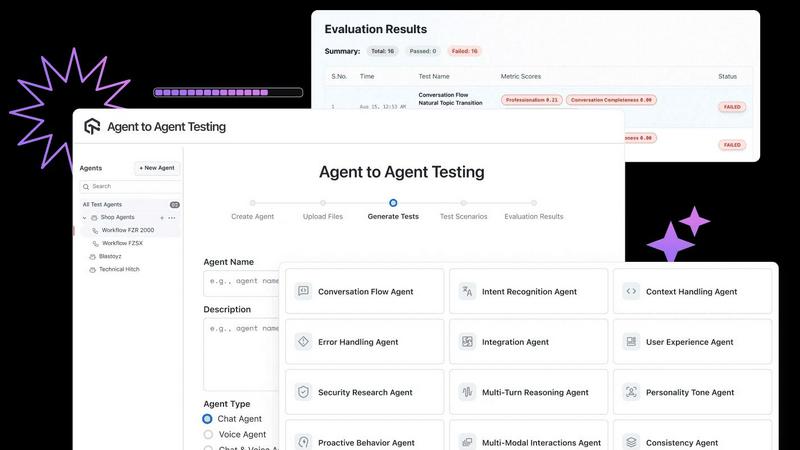
Agent to Agent Testing Platform
Project20x
Feature Comparison
Agent to Agent Testing Platform
Automated Scenario Generation
This feature allows for the automatic creation of diverse test cases for AI agents, simulating a range of interactions including chat, voice, and hybrid scenarios. This comprehensive testing approach ensures that the AI can handle various real-world situations effectively.
True Multi-Modal Understanding
With the capability to define detailed requirements or upload PRDs, this feature assesses how AI agents respond to diverse inputs like images, audio, and video. It mirrors real-world scenarios, providing insights into the agent's performance across different formats.
Autonomous Test Scenario Generation
Users have access to a library of hundreds of pre-defined scenarios or can create custom scenarios tailored to specific needs. This feature helps in evaluating various agent types, such as those focused on personality tone, data privacy, and intent recognition.
Diverse Persona Testing
This feature leverages a variety of personas to simulate different end-user behaviors and interactions. By incorporating personas like International Caller and Digital Novice, it ensures that AI agents perform effectively across a broad spectrum of user types.
Project20x
Governance Layer: AI-Powered Policy Crafting
This foundational layer assists lawmakers in developing robust, clear legislation. Using a ten-step AI methodology, it analyzes draft policies for linguistic clarity, internal consistency, and potential conflicts with existing laws. It acts as a collaborative digital advisor, ensuring that policies are sound, understandable, and effective from their very inception, long before they are implemented.
Management Layer: Rules as Code Automation
Once a policy is approved, this layer automatically translates the legal text into functional, executable code. This "Rules as Code" approach turns static regulations into dynamic, automated workflows for government agencies. It eliminates manual interpretation, reduces administrative overhead, and ensures consistent application of rules across all digital systems and processes.
Interface Layer: 24/7 Citizen AI Agents
This is the public-facing portal where citizens interact with government. It provides round-the-clock access to AI agents that are expertly trained on the codified policies from the Management Layer. Users can get instant, accurate answers to complex questions, apply for services, check eligibility, and complete transactions through a simple, conversational interface, much like using a helpful mobile app.
Full-Stack Transparency & Audit Trail
Project20x is built with accountability at its core. Every action, from a policy edit to a citizen query, is logged on an immutable audit trail. This ensures all governmental activities are traceable and quantifiable. The system operates with rigorous human oversight, providing complete transparency into how decisions are made and how automated outcomes are derived, building essential public trust.
Use Cases
Agent to Agent Testing Platform
Quality Assurance for Chatbots
Enterprises can utilize the platform to perform thorough testing of chatbots before they go live. By simulating real user interactions, businesses can identify issues related to bias, toxicity, and hallucinations, thereby enhancing user experience.
Voice Assistant Validation
Organizations can validate the performance of voice assistants by running extensive tests that replicate real-world usage. This ensures that these AI agents provide accurate and contextually relevant responses in voice interactions.
Phone Caller Agent Testing
The platform can be used to assess the effectiveness of phone caller agents. By simulating thousands of interactions, businesses can ensure that these agents handle customer inquiries with professionalism and empathy.
Regression Testing for Continuous Improvement
The Agent to Agent Testing Platform enables continuous regression testing as new features are added to AI agents. This ensures that updates do not introduce new issues, maintaining a high standard of quality and performance.
Project20x
Streamlining Business Licensing & Permits
A business owner can use the Project20x interface to navigate the complex requirements for a new license. The AI agent, trained on all relevant municipal codes, guides them step-by-step, checks their application for completeness in real-time, and automates the submission to the correct agency, drastically reducing processing time and confusion.
Legislative Drafting & Analysis for Lawmakers
A legislative team drafting a new environmental bill uses the Governance Layer. The AI analyzes the draft, flags ambiguous language, identifies potential overlaps with existing federal regulations, and suggests clearer terminology. This results in more precise, legally sound legislation that is easier for agencies to implement and for the public to understand.
Automated Benefits Eligibility & Distribution
A citizen seeking housing assistance can converse with an AI agent via the Interface Layer. The agent confidentially assesses their situation against the latest codified eligibility rules, instantly informs them of their qualification status, and can initiate the application process, ensuring fast, fair, and consistent access to critical support services.
Agency Workflow Optimization
A government agency like the Department of Education uses the Management Layer to codify a new student grant policy. The system automatically generates the digital forms, approval routing, and compliance checks. Caseworkers are freed from manual rule-checking, allowing them to focus on complex cases and citizen support, while ensuring 100% rule adherence.
Overview
About Agent to Agent Testing Platform
Agent to Agent Testing Platform is a pioneering AI-native quality assurance framework designed to validate the behavior of AI agents in real-world scenarios. As AI systems evolve to be more autonomous, traditional QA methodologies, which were built for static software, become inadequate. This platform addresses the pressing need for comprehensive testing by evaluating multi-turn conversations across various modalities including chat, voice, and phone interactions. It empowers enterprises to validate their AI agents before deployment, ensuring reliability and performance. The unique assurance layer it introduces leverages multi-agent test generation, utilizing over 17 specialized AI agents to expose long-tail failures, edge cases, and interaction patterns often overlooked in manual testing processes.
About Project20x
Project20x is the AI-native operating system for modern government, transforming how policies are created, managed, and accessed. Designed for government agencies, lawmakers, and citizens, it bridges the gap between complex regulatory frameworks and user-friendly digital services. The platform's core mission is to revolutionize governmental operations by making them more transparent, efficient, and accessible to everyone. It achieves this through a unique three-layer architecture: Governance, Management, and Interface. This structure ensures that from the initial drafting of legislation to the final citizen interaction, every step is enhanced by AI for clarity, automation, and ease of use. Project20x delivers a seamless, app-like experience, putting powerful governmental tools and services directly into the hands of users, 24/7. Its value proposition is clear: to build accountable, traceable, and quantifiable government processes that foster greater public trust and engagement.
Frequently Asked Questions
Agent to Agent Testing Platform FAQ
What types of AI agents can be tested using this platform?
The platform supports testing for a wide range of AI agents including chatbots, voice assistants, and phone caller agents. It is designed to evaluate their performance across various interaction modalities.
How does the platform ensure comprehensive testing?
The Agent to Agent Testing Platform employs automated scenario generation and multi-agent testing, creating diverse test cases that cover a broad spectrum of potential user interactions, including edge cases and long-tail failures.
Can I create custom test scenarios?
Yes, users can create custom scenarios tailored to specific requirements while also accessing a library of hundreds of pre-defined testing scenarios that cover various functionalities and performance metrics.
What metrics can be evaluated with this platform?
The platform evaluates key performance metrics such as bias, toxicity, hallucination, effectiveness, accuracy, empathy, and professionalism, providing a comprehensive analysis of AI agent performance.
Project20x FAQ
How does Project20x ensure the security of sensitive government and citizen data?
Project20x is built with enterprise-grade security as a foundational principle. All data is encrypted in transit and at rest. The platform features robust access controls, comprehensive audit trails for every action, and is designed to comply with stringent government security standards. Human oversight is integral to all automated processes, ensuring security protocols are always maintained.
Can Project20x integrate with existing government IT systems?
Yes, a core design principle of Project20x is interoperability. The platform is built with modern APIs and a modular architecture, allowing it to connect seamlessly with legacy databases, case management systems, and other critical government software. This ensures a smooth transition and enhances existing technological investments rather than replacing them outright.
How accurate are the AI agents when answering complex citizen questions?
The AI agents are uniquely accurate because they are not trained on general internet data but directly on the official, machine-readable "Rules as Code" from the Management Layer. This source-of-truth training, combined with continuous updates as policies change and a feedback loop for corrections, ensures responses are precise, current, and legally faithful.
What happens if a policy changes? How quickly does the system update?
When a policy is amended and officially approved through the Governance Layer, the update is immediately codified in the Management Layer. This change is then propagated to the training data for the Interface Layer's AI agents. This end-to-end integration allows the entire system, including public-facing services, to update almost in real-time, ensuring citizens always interact with the most current rules.
Alternatives
Agent to Agent Testing Platform Alternatives
The Agent to Agent Testing Platform is an innovative AI-native quality assurance framework designed specifically for validating the behavior of AI agents across various communication channels such as chat, voice, and phone interactions. As organizations increasingly rely on autonomous AI systems, traditional quality assurance methods often fail to address the complexities and unpredictability of these advanced technologies. Users frequently seek alternatives due to factors such as pricing, feature sets, and compatibility with existing infrastructure, as well as the need for a more tailored approach to their testing requirements. When looking for an alternative to the Agent to Agent Testing Platform, it's essential to consider various factors, including the comprehensiveness of testing capabilities, scalability, and the ability to simulate real-world interactions. Additionally, evaluate the platform's ability to ensure security and compliance, as well as the depth of insights it provides into AI agent performance. Prioritizing these aspects can significantly enhance your decision-making process and lead to a solution that better fits your organization's needs.
Project20x Alternatives
Project20x is a specialized AI governance platform designed for government agencies and lawmakers. It helps translate complex policies into clear, automated digital workflows and public-facing AI agents. This places it in a niche category focused on public sector digital transformation and regulatory technology. Users often explore alternatives for several reasons. Budget constraints or specific procurement processes can drive the search for different pricing models. Some organizations might need a tool that integrates with existing legacy systems, or they may require features tailored for a different level of government or a specific regulatory domain. When evaluating other options, consider the platform's core methodology for policy analysis and "Rules as Code" automation. Look for strong security credentials and audit trails, as handling government data demands the highest standards. Finally, assess the citizen engagement tools to ensure they provide the intuitive, 24/7 access that modern public service delivery requires.