
Fallom vs qtrl.ai
Side-by-side comparison to help you choose the right AI tool.

Fallom tracks every AI agent action and LLM call in real time for full observability.
Last updated: February 28, 2026

qtrl.ai
qtrl.ai empowers QA teams to scale testing with AI while maintaining control, governance, and seamless integration.
Last updated: March 4, 2026
Visual Comparison
Fallom
qtrl.ai
Feature Comparison
Fallom
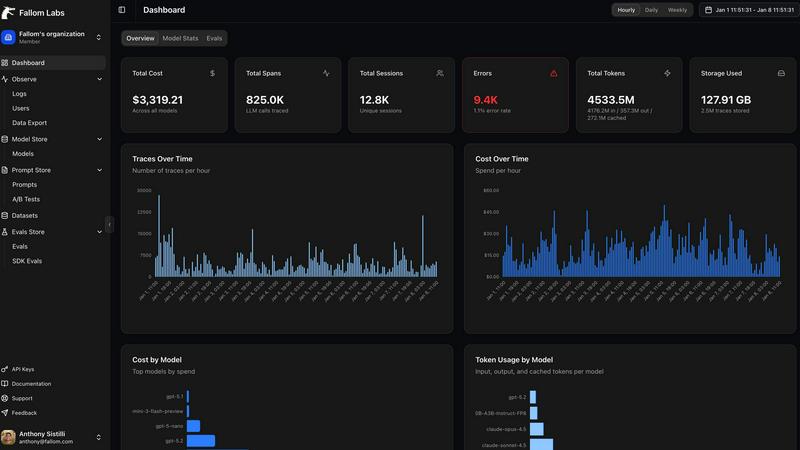
Real-Time LLM Call Dashboard
Monitor every AI interaction live from a centralized, mobile-friendly dashboard. See prompts, model outputs, token counts, latency, and cost for each call in real-time. Click into any trace for a detailed breakdown, enabling instant debugging and performance monitoring without sifting through logs.
Granular Cost Attribution & Analytics
Gain full financial transparency over your AI operations. Fallom automatically tracks and attributes spend per model, per user, per team, or per customer. Visualize costs with clear charts and reports, enabling accurate budgeting, chargeback, and optimization to control your LLM expenditure effectively.
Compliance-Ready Audit Trails
Meet stringent regulatory requirements like the EU AI Act, SOC 2, and GDPR with built-in compliance features. Fallom provides immutable, complete audit trails of every LLM interaction, including input/output logging, model versioning, and user consent tracking, all essential for enterprise deployments.
Advanced Debugging with Timing Waterfalls & Tool Visibility
Debug complex, multi-step agent workflows with precision. Visualize latency bottlenecks using timing waterfall diagrams that break down each step of an agent's execution. Inspect every function or tool call your agent makes, including arguments and results, to quickly identify and resolve issues.
qtrl.ai
Autonomous QA Agents
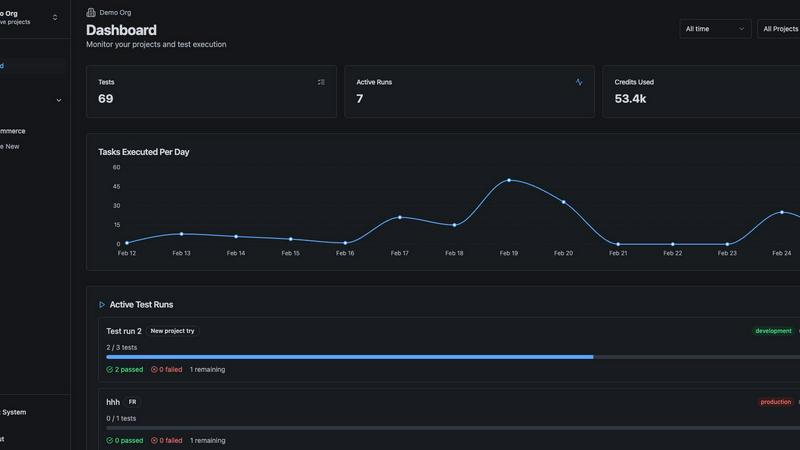
qtrl.ai's Autonomous QA Agents execute instructions on demand or continuously across various environments. They adhere to user-defined rules to ensure compliance and reliability, running real browser executions rather than simulations.
Enterprise-Grade Test Management
With centralized management of test cases, plans, and runs, qtrl.ai offers full traceability and audit trails. This feature supports both manual and automated workflows, ensuring that compliance and auditability are built-in, which is crucial for enterprise environments.
Progressive Automation
Begin with human-written test instructions and transition to AI-generated tests as your team becomes more comfortable. qtrl.ai intelligently suggests new tests based on coverage gaps, allowing teams to review, approve, and refine tests at every phase of development.
Adaptive Memory
qtrl.ai builds a living knowledge base of your application, learning from test executions and issues. This adaptive memory enhances context-aware test generation, becoming more effective with each interaction, which significantly improves overall testing efficiency.
Use Cases
Fallom
Debugging Complex Agentic Workflows
When your multi-step AI agent fails or behaves unexpectedly, Fallom provides the clarity needed. Trace the entire execution path, view the exact inputs and outputs at each step (LLM calls, tool calls), and analyze timing waterfalls to pinpoint exactly where and why the failure occurred, drastically reducing mean time to resolution.
Managing and Optimizing LLM Costs
Gain control over unpredictable AI spending. Use Fallom's cost attribution dashboards to see which models, teams, or features are driving your bill. Identify inefficiencies, compare cost-performance of different models through A/B testing, and set up alerts for anomalous spend to maintain budget predictability.
Ensuring Compliance and Audit Readiness
For teams in regulated industries, Fallom automates the creation of a verifiable audit trail. Document every AI decision for compliance reviews, demonstrate user consent logging, and utilize privacy modes for sensitive data. This ensures your LLM applications meet legal and internal governance standards from day one.
Monitoring Production Reliability and Performance
Proactively ensure your AI features are reliable and fast. Set up real-time monitors on key metrics like latency, error rates, and token usage. Get alerted to performance degradation or model outages immediately, allowing you to maintain a high-quality user experience and trust in your AI-powered products.
qtrl.ai
Product-Led Engineering Teams
For product-led engineering teams, qtrl.ai streamlines the QA process by integrating test management and automation into one cohesive platform. This allows teams to focus on delivering high-quality features without sacrificing speed.
QA Teams Scaling Beyond Manual Testing
QA teams transitioning from manual testing can leverage qtrl.ai to automate their workflows progressively. This enables them to maintain oversight while reducing the time spent on repetitive tasks, leading to better resource allocation.
Companies Modernizing Legacy QA Workflows
Organizations modernizing their QA workflows can benefit from qtrl.ai's structured approach to test management and automation. This facilitates smoother transitions from outdated practices to modern, efficient QA strategies that enhance product quality.
Enterprises Requiring Governance and Traceability
Enterprises with strict compliance requirements will find qtrl.ai's full traceability and audit trails invaluable. The platform is designed to meet governance needs, ensuring that every testing phase is documented and compliant with industry standards.
Overview
About Fallom
Fallom is the AI-native observability platform built for teams deploying production-grade LLM applications and autonomous agents. It transforms the opaque "black box" of AI interactions into a transparent, actionable window, giving developers, AI engineers, and platform teams complete, real-time visibility. The core challenge it solves is the inability to effectively monitor, debug, and manage the cost, performance, and reliability of complex LLM workloads at scale. Fallom's primary value proposition is delivering enterprise-ready observability in minutes through a single, OpenTelemetry-native SDK. With Fallom, you can see every granular detail of an LLM call—including prompts, outputs, tool calls, token usage, latency, and cost—all seamlessly correlated with session and user context. This empowers teams to swiftly debug intricate agentic workflows, accurately attribute spend across models and teams, ensure compliance with detailed audit trails, and maintain system reliability, all from an intuitive, mobile-friendly dashboard. Fallom ensures organizations can innovate and move fast with AI without flying blind, guaranteeing their applications are performant, cost-effective, and trustworthy from day one.
About qtrl.ai
qtrl.ai is an innovative quality assurance (QA) platform that empowers software teams to elevate their QA processes without compromising on control or governance. By merging robust test management capabilities with advanced AI automation, qtrl.ai serves as a centralized hub for organizing test cases, planning test runs, tracing requirements to coverage, and monitoring quality metrics through intuitive real-time dashboards. This comprehensive structure provides engineering leads and QA managers with clear insights into testing progress, pass rates, and potential risks. What sets qtrl.ai apart is its progressive AI layer, allowing teams to gradually implement intelligent automation. Starting with manual test management, teams can evolve to leverage autonomous agents that generate UI tests from simple English descriptions, adapt to application changes, and execute tests across various browsers and environments. This flexibility makes qtrl.ai ideal for product-driven engineering teams, QA departments moving past manual testing, organizations modernizing their legacy workflows, and enterprises with stringent compliance needs. Ultimately, qtrl.ai bridges the divide between the slow nature of manual testing and the complexities of traditional automation, providing a reliable pathway toward faster and more intelligent quality assurance.
Frequently Asked Questions
Fallom FAQ
How quickly can I integrate Fallom into my existing application?
Integration is designed to be incredibly fast. Using the OpenTelemetry-native SDK, you can typically start sending traces and seeing data in the Fallom dashboard in under 5 minutes. There's no need to change your LLM provider or application architecture.
Does Fallom support all major LLM providers and frameworks?
Yes, Fallom is provider-agnostic. Its single SDK works with every major provider like OpenAI, Anthropic, Google Gemini, and open-source models. It also integrates with popular agent frameworks (LangChain, LlamaIndex) and is 100% compatible with the OpenTelemetry standard, ensuring zero vendor lock-in.
How does Fallom handle sensitive or private user data?
Fallom offers robust privacy controls for sensitive deployments. You can enable "Privacy Mode" to disable full content capture, logging only metadata like token counts and latency. Configurable content redaction and per-environment settings allow you to balance observability needs with data protection and compliance requirements.
Can I use Fallom for A/B testing different models or prompts?
Absolutely. Fallom includes features specifically for experimentation. You can split traffic between different models (e.g., GPT-4 vs. Claude) or different versions of your prompts stored in the Prompt Store. Compare their performance, cost, and quality metrics side-by-side in the dashboard to make data-driven decisions before full rollout.
qtrl.ai FAQ
What makes qtrl.ai different from traditional QA tools?
qtrl.ai uniquely combines enterprise-grade test management with progressive AI automation, allowing teams to scale their QA efforts without losing control. Unlike traditional tools, qtrl.ai enables incremental adoption of automation.
Can qtrl.ai integrate with existing tools?
Yes, qtrl.ai is built to support existing workflows and can integrate with various tools in your CI/CD pipeline. This ensures a seamless transition and enhances the overall efficiency of your QA processes.
How does adaptive memory work in qtrl.ai?
Adaptive memory in qtrl.ai accumulates knowledge from your application through test executions and issues. This ongoing learning process powers smarter, context-aware test generation, making the platform increasingly effective over time.
Is qtrl.ai suitable for teams with strict compliance needs?
Absolutely. qtrl.ai is designed with governance in mind, offering full traceability and audit trails essential for enterprises that require strict compliance and oversight in their QA processes.
Alternatives
Fallom Alternatives
Fallom is an AI-native observability platform designed for teams running production LLM applications and autonomous agents. It provides real-time visibility into every AI interaction, helping developers monitor, debug, and manage costs. Users often explore alternatives for various reasons, such as budget constraints, specific feature needs like deeper integration with certain cloud providers, or a preference for a different deployment model like self-hosted solutions. When evaluating other options, key factors to consider include the depth of tracing for agentic workflows, real-time cost tracking capabilities, ease of integration with your existing stack, and the overall user experience for debugging and monitoring at scale.
qtrl.ai Alternatives
qtrl.ai is a cutting-edge QA platform that empowers software teams to enhance their quality assurance processes through AI-driven automation while maintaining full control and governance. As part of the automation and development tools category, qtrl.ai offers a centralized hub for organizing test cases, planning test runs, and tracking quality metrics, making it a favorite among product-led engineering teams and QA groups looking to evolve from manual testing. Users often seek alternatives to qtrl.ai for various reasons, including pricing concerns, specific feature requirements, or compatibility with existing platforms. When exploring alternatives, it’s essential to consider factors like ease of integration, the flexibility of automation capabilities, and the level of support provided. A thorough evaluation of these aspects will help ensure that the selected solution aligns with your team's unique needs and enhances your quality assurance strategy.