
ScopeSnap vs Skene
Side-by-side comparison to help you choose the right AI tool.

ScopeSnap
ScopeSnap uses AI to turn your project notes into client-ready proposals and estimates in minutes.
Last updated: March 18, 2026

Skene transforms your codebase into a self-driven growth engine that empowers your product and enhances user experience.
Last updated: February 28, 2026
Visual Comparison
ScopeSnap
Skene
Feature Comparison
ScopeSnap
AI-Powered Scope Generation
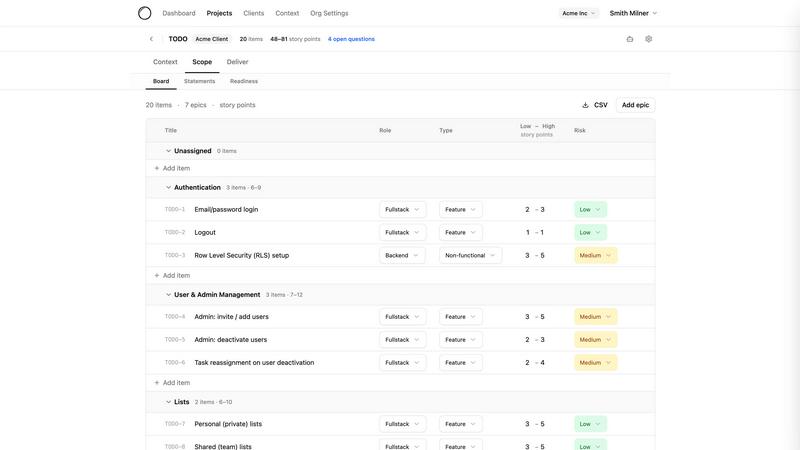
Paste in your unstructured discovery notes, meeting transcripts, or email threads. ScopeSnap's AI instantly analyzes the text to identify key requirements, breaking them down into a structured backlog of epics and individual scope items. It intelligently surfaces critical open questions and flags underlying assumptions that need clarification, giving you a powerful head start and ensuring nothing important is overlooked from the initial conversation.
Interactive Scope Refinement Board
The generated scope is presented in a clear, interactive board where you can review, edit, and organize every item. Drag and drop to prioritize, split large items into smaller tasks, and add detailed descriptions. You can assign roles (e.g., frontend, backend) and attach time or cost estimates directly to each scope item. This visual, tactile interface makes collaborative refinement simple and ensures every feature is well-understood before estimation.
Automated Proposal & SOW Creation
Once your scope and estimates are finalized, ScopeSnap automates the most tedious part. With a single click, it compiles all your structured work into a polished, client-ready document. You can generate formal Proposals for new projects or detailed Statements of Work for existing clients. This feature eliminates hours of copying, pasting, and formatting, delivering a professional document that builds trust and clarity from the outset.
Centralized Project Context Hub
ScopeSnap acts as a single source of truth for your project's definition. It securely stores all your initial discovery notes, the evolving scope backlog, all resolved questions, and the final estimates and proposals. This centralized hub makes it easy to reference original context during development, onboard team members, and maintain alignment with clients, preventing scope creep and misunderstandings later in the project lifecycle.
Skene
Automated Growth Engine
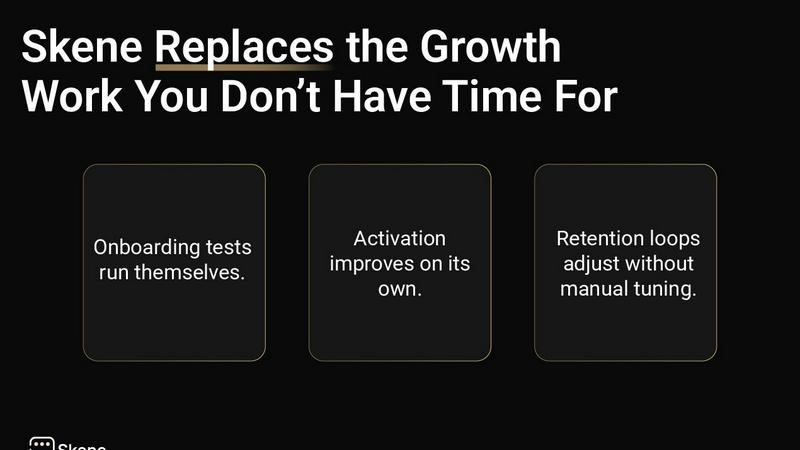
Skene provides a fully automated growth engine that learns from real user interactions within your product. By directly analyzing your codebase, it identifies friction points and opportunities for improvement without the need for manual intervention.
Seamless Codebase Integration
Unlike traditional PLG tools, Skene connects directly to your GitHub or GitLab repository for read-only access. This integration allows it to analyze your codebase and generate onboarding, analytics, and lifecycle automation effortlessly.
Real-Time Analytics Dashboard
Skene features a comprehensive analytics dashboard that tracks user progress, completion rates, and engagement metrics in real-time. It helps identify bottlenecks and measure the impact of improvements, allowing for data-driven optimization of user flows.
Prompt-Driven Implementation
With Skene, developers can utilize prompt-driven implementation for growth strategies. This feature enables users to generate and deploy growth loops and onboarding experiences directly from their coding environment, ensuring a streamlined workflow.
Use Cases
ScopeSnap
For Freelance Developers Closing New Clients
Independent developers can use ScopeSnap to quickly transform a post-discovery call mess of ideas into a compelling, detailed proposal. Instead of spending a full day writing a Scope of Work from scratch, they can generate a structured scope in minutes, refine it with confidence, and send a professional document that demonstrates expertise and thoroughness, significantly increasing their chances of winning the project.
For Software Agencies Streamlining Pre-Sales
Small to mid-sized agencies can standardize their scoping process across their entire team. ScopeSnap ensures every project manager or lead developer follows the same rigorous methodology, turning varied discovery notes into consistently structured scopes. This leads to more accurate estimations, reduces internal review time, and allows the agency to present a unified, high-quality front to all potential clients.
For Consultants Defining Project Phases
Technical consultants who need to break large, complex engagements into distinct phases use ScopeSnap to create clear deliverables for each stage. The AI helps identify logical milestones and dependencies, while the refinement board allows for easy grouping of tasks into Phase 1, Phase 2, etc. This makes it easy to create phased proposals with clear objectives and costs for each step.
For Managing Scope Changes Mid-Project
When a client requests new features or changes during development, ScopeSnap provides a framework to assess the impact. You can quickly add the new requirements to the existing scope board, estimate the additional work, and generate a formal change order or amended SOW. This professional approach manages client expectations and protects against uncompensated scope creep.
Skene
Enhancing Onboarding Experiences
Skene can transform the onboarding process for new users by automatically detecting and addressing friction points that hinder activation. This ensures a smoother user journey and improves initial engagement.
Driving Feature Adoption
By continuously analyzing user behavior and engagement, Skene identifies which features are underutilized. It then creates targeted prompts and flows to encourage users to explore and adopt these features, enhancing overall product value.
Optimizing Retention Strategies
Skene's real-time analytics allow teams to monitor user retention closely. By identifying drop-off points, it facilitates the deployment of tailored interventions aimed at keeping users engaged over the long term.
Streamlining Product Iterations
For developers working in fast-paced environments, Skene enables rapid iterations of product features. Its automated system ensures that any code changes are reflected in the growth strategies without manual updates or maintenance, allowing for continuous improvement.
Overview
About ScopeSnap
ScopeSnap is an AI-powered scoping and proposal platform designed specifically for freelance developers, consultants, and software agencies. It tackles the most tedious and error-prone part of the project lifecycle: turning chaotic discovery notes into a clear, actionable plan. The core problem it solves is the slow, risky process of manual scoping, where important requirements are often missed, estimates are guesswork, and creating client-ready proposals takes hours of repetitive work.
The app provides a structured, mobile-friendly workflow that guides you from raw input to a finalized deliverable. You start by feeding it context from discovery calls, like meeting transcripts, emails, or notes. ScopeSnap's AI then analyzes this information to automatically generate a structured project backlog with epics, scope items, open questions, and flagged assumptions. Within the app, you can iteratively refine this scope, assign roles, and set confident estimates. Finally, with one click, it transforms your polished scope into a professional Proposal or Statement of Work, ready to send to your client. The main value proposition is saving significant time, reducing risk, and increasing win rates by delivering exceptionally clear and professional scopes from the very start of a project.
About Skene
Skene is an innovative AI-powered Product-Led Growth (PLG) infrastructure that revolutionizes how digital products scale and thrive in competitive markets. Designed specifically for indie developers, early-stage startups, and product-led companies, Skene eliminates the need for cumbersome manual A/B testing and reliance on external analytics tools. Instead, it integrates seamlessly with your codebase, providing a self-learning growth engine that observes real user interactions to identify friction points, activation drop-offs, and retention opportunities. By creating, testing, and deploying enhanced user flows automatically, Skene ensures continuous optimization of onboarding, activation, and retention. Its core value proposition lies in transforming growth into code that developers own and control, allowing for performance and data ownership while avoiding the pitfalls of third-party scripts and siloed analytics. With a setup time of less than 60 seconds, Skene acts as a "growth team in a box," empowering builders to enhance product experiences directly from their Integrated Development Environment (IDE).
Frequently Asked Questions
ScopeSnap FAQ
What kind of input does ScopeSnap need to work?
ScopeSnap is designed to work with the raw, unstructured text you already have from discovery. You can paste in notes from your notepad, transcripts from meeting recording tools, or email chains discussing the project. The AI analyzes this text to identify requirements, goals, and features, so the more context you provide, the more accurate the initial scope generation will be.
How accurate are the AI-generated estimates?
ScopeSnap's AI is designed to help you create a structured scope, not to provide final estimates on its own. The primary value is in breaking down the project into clear, estimatable tasks. You, as the expert, review and assign the final estimates to each task based on your experience. This human-in-the-loop process ensures accuracy while saving you the time of building the entire breakdown manually.
Can I customize the generated proposals?
Yes. The automated proposals and Statements of Work are generated from templates that incorporate your refined scope, estimates, and project details. You have full control to edit the final document before sending it. You can adjust language, add terms and conditions, include your branding, and modify any section to perfectly fit your client engagement style and contract needs.
Is my client data secure within ScopeSnap?
Security is a priority. ScopeSnap employs industry-standard measures to protect your data and your clients' information. This includes encryption in transit and at rest. We do not use your project data to train public AI models. For specific details on data handling, storage, and privacy practices, please refer to the comprehensive Privacy Policy available on the ScopeSnap website.
Skene FAQ
What is PLG software?
PLG (Product-Led Growth) software automates the user journey, allowing users to discover value in your product without needing intervention from sales or customer success teams. It guides users toward activation and drives feature adoption through the product itself.
How is Skene different from traditional customer experience software?
Traditional customer experience tools rely on manual tour creation and maintenance, often using brittle UI overlays. In contrast, Skene analyzes your codebase to generate onboarding and lifecycle automation automatically, updating itself with every code push.
How long does it take to set up?
Setting up Skene takes less than 60 seconds. Simply connect your GitHub or GitLab repository for read-only access, and Skene will analyze your codebase to generate PLG flows without requiring code changes or API modifications.
Is my code secure?
Yes, your code is secure with Skene. The platform requires only read-only access to your repository, and all analysis occurs in a secure, isolated environment to ensure your data remains protected.
Alternatives
ScopeSnap Alternatives
ScopeSnap is an AI-powered productivity tool designed to streamline the project scoping and proposal process for software developers and agencies. It helps turn initial client conversations into structured, estimatable tasks and professional documents, saving significant time and reducing risk. Users often explore alternatives for various reasons. Some may need different pricing models, specific integrations with their existing project management stack, or more advanced features for larger teams. Others might simply prefer a different user interface or workflow approach. When evaluating other options, consider the core value: how effectively the tool translates vague requirements into clear, actionable scopes. Look for solutions that offer collaborative features, flexibility in estimation, and the ability to generate client-ready proposals directly, ensuring the tool fits seamlessly into your mobile and desktop workflow.
Skene Alternatives
Skene is an AI-powered Product-Led Growth (PLG) infrastructure designed to optimize digital product growth by transforming codebases into self-learning growth engines. It is an innovative solution for indie developers, early-stage startups, and product-led companies, allowing them to enhance user experiences and drive growth without the complexities of traditional methods like manual A/B testing or hiring specialized teams. Users often seek alternatives to Skene due to various factors, including cost considerations, specific feature requirements, or compatibility with their existing tech stacks. When exploring alternatives, it's essential to evaluate factors such as ease of integration, the comprehensiveness of analytics, and the automation capabilities offered. A strong alternative should provide a seamless experience, enabling developers to maintain control over their growth strategies while delivering an enhanced user journey.