AI tool Details
Explore More
Alternatives
About act101
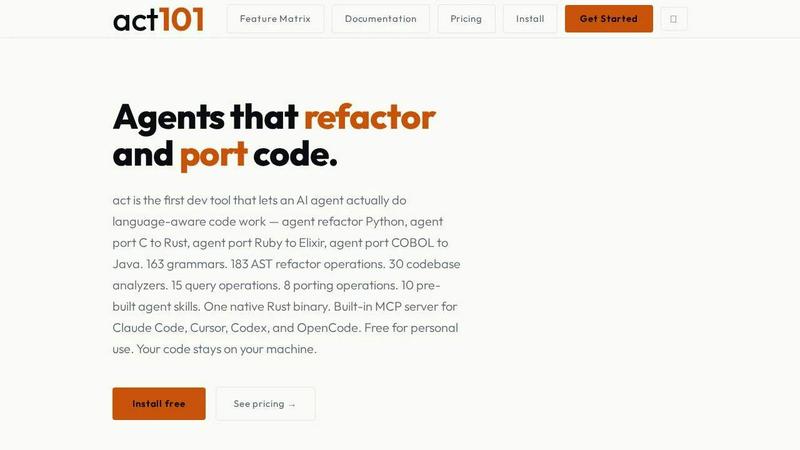
act101 is a groundbreaking developer tool that fundamentally changes how AI coding agents interact with your codebase. Unlike traditional AI coding assistants that rely on whole-file rewrites, act101 is the first tool that gives AI agents the ability to perform precise, language-aware code operations across 163 programming languages. It functions as a Model Context Protocol (MCP) server, exposing a rich set of 183 AST refactor operations, 30 codebase analyzers, 15 query operations, and 8 porting operations to popular AI clients like Claude Code, Cursor, Codex, and OpenCode. For developers, this means your AI agent can now actually refactor Python, port C to Rust, migrate Ruby to Elixir, or even transform COBOL to Java with surgical precision. The tool is built as a single native Rust binary with no external dependencies, no indexing, and no telemetry. Your code never leaves your machine. It is free for personal use and offers instant checkpointing and undo on every operation, making it safe and reliable for real-world development workflows.
Features
AST-Aware Refactor Operations
act101 provides 183 AST-aware refactor operations that go far beyond simple find-and-replace or whole-file rewrites. These operations include extract-function, rename, move-symbol, inline, convert-to-dataclass, extract-trait, add-type-hints, generate-init, organize-imports, and 174 more. Each operation understands the syntax tree of the target language, ensuring that changes are syntactically correct and maintain code formatting, comments, and cross-file consistency. The agent can apply these operations across your entire codebase with automatic checkpointing and instant undo, giving you complete control and safety.
Cross-Language Porting Engine
The porting feature is a state machine driven by four key operations: port_contract to anchor the source-to-target migration, port_inventory to enumerate every symbol that must move, port_order to resolve dependency ordering, and port_manifest to track progress step by step. This system works between any two of the 163 supported grammars, enabling AI agents to perform end-to-end language migrations. Whether you are porting C to Rust, Ruby to Elixir, or COBOL to Java, the agent follows a structured, verifiable process that maintains code semantics and structure.
Comprehensive Codebase Analysis
act101 includes 30 built-in codebase analyzers that give your AI agent a deep structural understanding of your repository before it modifies a single line. These analyzers cover cohesion, coupling, cycles, chokepoints, hotspots, dead code, layers, seams, clusters, surface, fan balance, migration readiness, and type completeness. The agent uses this analysis to make informed decisions about refactoring, migration, and optimization strategies. This structural map is generated on demand with no indexing or caching, so results are always current and never stale.
Pre-Built Agent Skills
The tool comes with 10 pre-built agent skills that compose the individual operations into common engineering workflows. These skills include architecture-audit, code-review, refactoring, code-navigation, code-generation, migration-assessment, boundary-analysis, change-impact, health-check, and architectural-refactoring. You can invoke these skills with simple commands like /skill-name in Claude Code, Cursor, or other MCP-aware clients. Each skill orchestrates multiple operations to complete complex tasks, saving you time and ensuring consistency.
Use Cases
Automated Code Refactoring
When you need to refactor a large Python codebase, act101 allows your AI agent to perform precise operations like extracting functions, renaming symbols across files, converting classes to dataclasses, or adding type hints. The agent can apply these changes with full AST awareness, preserving formatting and comments. Automatic checkpointing on every operation means you can instantly undo any change that looks wrong, making large-scale refactoring safe and efficient.
Cross-Language Migration
act101 excels at porting code from one language to another. For example, if you have a legacy C library that needs to be rewritten in Rust, the agent uses the porting state machine to create a contract, inventory every symbol, resolve dependency order, and track progress. This structured approach ensures that nothing is missed during migration, and the resulting code maintains the original semantics while following idiomatic patterns of the target language.
Codebase Health Assessment
Before starting a major refactoring effort, you can use act101 to perform a comprehensive health assessment of your codebase. The agent runs all 30 analyzers to identify coupling issues, cyclic dependencies, dead code, hotspots, and architectural boundaries. This analysis provides a clear structural map that helps you prioritize which areas need attention, making your refactoring efforts more targeted and effective.
Continuous Code Review
Integrate act101 into your development workflow to automate code reviews. The code-review skill analyzes pull requests for architectural issues, coupling problems, and potential refactoring opportunities. The agent can suggest specific AST operations to improve code quality, and you can apply them with a single command. This turns code review from a manual, time-consuming process into an automated, actionable workflow.
Pricing
act101 is free for personal use. For team and enterprise pricing, please visit the official website for detailed plan information and pricing tiers.
Frequently Asked Questions
How does act101 keep my code private and secure?
act101 is built as a native Rust binary that runs entirely on your machine. It does not send your code to any external servers, and it has no telemetry features. The only external communication is for license verification, which is minimal and does not involve your source code. There is no indexing, caching, or cold start, so your code never leaves your local environment.
What AI coding agents are compatible with act101?
act101 works with any AI coding agent that supports the Model Context Protocol (MCP). This includes Claude Code, Cursor, Codex, Windsurf, and OpenCode. The tool exposes its operations through a built-in MCP server, so you can integrate it seamlessly with your preferred AI coding assistant without additional configuration.
How many languages and operations does act101 support?
act101 supports 163 programming language grammars in a single binary. It provides 183 AST refactor operations, 30 codebase analyzers, 15 query operations, and 8 porting operations. Additionally, there are 10 pre-built agent skills that compose these operations into common workflows. This comprehensive coverage makes it suitable for virtually any programming language or development scenario.
Is act101 free to use and how do I install it?
act101 is free for personal use. You can install it by downloading the single native Rust binary from the official website. There is no package manager dependency, no runtime requirement, and no plugin system. Simply download the binary, configure it with your MCP client, and start using it immediately. For team or enterprise pricing, you can check the pricing page on the website.
Similar to act101

Product Launch Checklist
A free launch checklist for SaaS, apps, AI tools and more. Every step says why it matters and when you can skip it.


laya.tools
Free directory of 950+ projects built on Laya, the open-source model that turns text into typed decisions. Ports, SDKs, agents and demos.

Forms Plugin
The #1 Native Form Builder Plugin for Framer - No Code, No Embeds, No External Platforms.