AI tool Details
Explore More
Alternatives
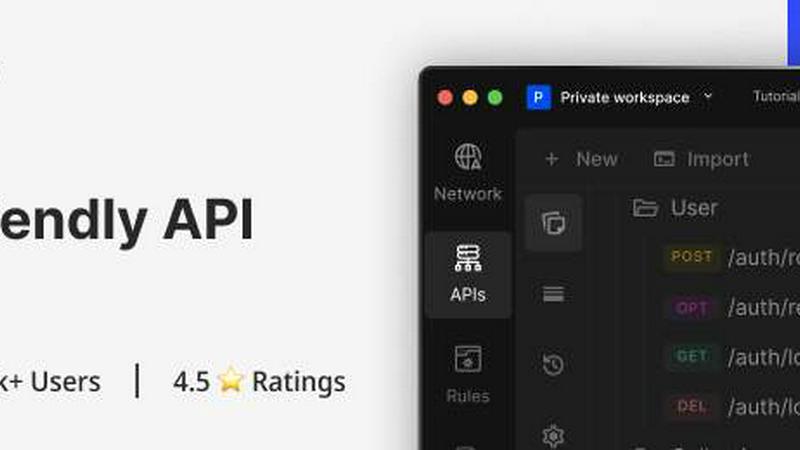
About Requestly
Requestly is a modern, lightweight desktop API client built for developers and teams who value speed, control, and developer-centric workflows. It directly addresses the frustrations of bloated, cloud-dependent tools by championing a local-first architecture. This means all your API collections, environments, and request history are stored as files on your own machine, giving you unparalleled data security and privacy. Its core value proposition is seamless integration with a developer's natural workflow: it's Git-native. By storing collections as files, Requestly enables effortless version control, branching, and collaboration using the Git tools your team already knows. With no mandatory login or account creation, you can start testing APIs in seconds. It supercharges productivity with built-in AI assistance for writing requests, generating tests, and debugging. Trusted by over 300,000 developers from top tech companies, Requestly offers a powerful, free-tier alternative to traditional clients, supporting both REST and GraphQL with features like schema introspection, environment variables, and pre/post-request scripts, all designed to keep you in the flow state without compromise.
Features
Git-Native Collections
Requestly revolutionizes API management by storing your collections as local files (JSON/YAML). This Git-native approach allows you to version control your API specs alongside your codebase, use branches for different features, and review changes through pull requests. It eliminates vendor lock-in and ensures your API definitions are portable, secure, and always under your control, fostering true collaboration through the tools developers already use every day.
Local-First & Login-Free Operation
Experience instant productivity with absolutely no sign-up required. Requestly operates on a local-first principle, meaning all your data—collections, environments, variables, and logs—resides securely on your computer. This guarantees maximum privacy, offline access, and removes the friction and security concerns associated with cloud-synced accounts. You get a full-featured API client immediately upon download, putting you in complete command of your data.
AI-Powered API Development
Embedded AI capabilities accelerate your entire API workflow. From drafting complex requests and generating test cases to explaining errors and suggesting fixes, Requestly's AI assistant acts as a co-pilot. It helps debug responses faster, auto-completes queries, and streamlines documentation, significantly reducing manual effort and making the development and testing process more intuitive and efficient for both beginners and experts.
Free Team Collaboration & RBAC
Collaborate seamlessly without cost barriers. Requestly's free tier includes shared workspaces where teams can organize and manage APIs together. It features robust Role-Based Access Control (RBAC), allowing you to assign team members as Admins, Editors, or Viewers with precise permissions. Combined with Git sync, this provides a powerful, free collaboration model that scales from small projects to large enterprise teams.
Use Cases
Migrating from Postman Without Disruption
Teams tired of bloated, slow clients can switch to Requestly instantly. With a one-click import for Postman collections and environments, you can migrate your entire API workflow in seconds. This allows teams to regain control with a local-first, Git-native tool without losing any existing work or disrupting their current processes, enjoying a faster, more developer-friendly alternative immediately.
Version-Controlled API Development
Development teams building microservices or public APIs can use Requestly to treat API collections as code. By storing request definitions in Git repositories, they can implement proper versioning, conduct code reviews on API changes via pull requests, and maintain a clear audit trail. This ensures consistency between backend implementations and API contracts throughout the development lifecycle.
Secure Internal API Testing for Enterprises
Organizations with strict data security and compliance requirements (like SOC-II) benefit from Requestly's local-first approach. Sensitive API keys, payloads, and internal endpoints never leave the developer's machine or company network. Features like SSO integration, RBAC, and encrypted local storage make it an enterprise-ready solution for testing internal APIs without exposing data to third-party clouds.
Rapid GraphQL Endpoint Exploration
Frontend and full-stack developers working with GraphQL can leverage Requestly's intelligent client for rapid endpoint exploration and testing. Features like schema introspection, auto-completion for queries and mutations, and variable management streamline the process of understanding and interacting with GraphQL APIs, making it ideal for prototyping and debugging data-fetching logic.
Frequently Asked Questions
How is Requestly different from Postman?
Requestly is built as a lightweight, local-first alternative. Key differences include no mandatory login, storing collections as Git-friendly files for version control, and a focus on performance without bloat. While both support REST/GraphQL, Requestly offers free team collaboration and RBAC, whereas Postman limits collaboration in its free tier. Requestly prioritizes developer workflow integration and data privacy.
Is my API data secure with Requestly?
Absolutely. Requestly employs a local-first architecture, meaning your collections, environment variables, and request history are stored as files on your own computer by default. Your sensitive data (like API keys) is not automatically sent to any cloud server. For enterprises, additional features like data encryption, SSO, and SOC-II compliance provide layers of security for shared workflows.
Can I collaborate with my team for free?
Yes. Unlike many competitors, Requestly offers free team collaboration. You can create shared workspaces and invite team members at no cost. It includes Role-Based Access Control (RBAC) to manage permissions (Admin, Editor, Viewer). Collaboration is enhanced by its Git-native nature, allowing teams to use Git branches and pull requests to manage changes to API collections.
How do I import my existing Postman collections?
You can import your Postman data into Requestly in a single click. Within the Requestly app, use the import functionality and select your exported Postman collection (JSON) file. It will seamlessly bring in your collections, environments, and scripts. This makes switching from Postman to Requestly a quick and non-disruptive process, allowing you to start benefiting from the new workflow immediately.
Similar to Requestly
Forms Plugin
The #1 Native Form Builder Plugin for Framer - No Code, No Embeds, No External Platforms.






Firma.dev
Pay-as-you-go e-signature API and no-code sending. €0.049 per envelope, no monthly minimums, legally valid in 55+ countries.